
What is cyclical living? To put it simply, cyclical living is about following nature’s lead. It’s about aligning the way we live with the natural rhythms that sustain us and life on Earth.
The cycles of nature provide us with more than beautiful sunsets, fall leaves, and glistening snow. The earth, life, and even the individual cells inside our bodies depend on cycles and rhythms. The rising and setting of the sun help regulate when we wake and sleep, influencing biological processes including the release of hormones such as cortisol and melatonin.
Even every breath we take participates in a cycle. Breathing in fills our lungs with oxygen. Breathing out releases carbon dioxide. Our lungs expand and contract, over and over again, in a rhythm that continues throughout our lives.
The natural rhythms we see in the world can be calm and gentle, but they can also be intense, destructive, and dark. Nature doesn’t give us endless sunshine and growth. There are storms. Leaves fall. Plants die back. Winter arrives. Yet these periods of darkness, dormancy, release, and change are as much a part of the natural world as growth and renewal.
What if these cycles were meant to be revered and honored as sacred teachers? What if instead of seeing nature as something separate from us, we allowed its rhythms to teach us something about how to live?
We live in a world where we are often expected to have the same energy every day. If we feel drained or exhausted, we push ourselves to show up anyway. When we fall behind, we may work even harder to catch up when our bodies are already telling us they need rest.
But what if we were never meant to live this way? What if our bodies, much like nature, were meant to move through cycles? What if periods of expansion were naturally followed by periods of contraction, rest, reflection, release, and eventually renewal?
This is the heart of cyclical living.
What Is Cyclical Living?
Cyclical living is a way of approaching life with greater awareness of the rhythms occurring both within us and around us.
Instead of expecting our energy, creativity, emotions, needs, and capacity to remain constant, we begin paying attention to how they naturally change.
Living cyclically doesn’t mean abandoning responsibilities whenever we don’t feel energetic or organizing every part of life around a prescribed cycle. We still have jobs to go to, families to care for, appointments to keep, and responsibilities that don’t conveniently disappear because we’re in a period of lower energy.
The difference is awareness.
Rather than automatically pushing against every period of contraction, cyclical living asks us to become curious about it. What is happening within my body right now? What do I need? Is this a time for movement or stillness? Creation or reflection? Connection or solitude? Is there something I need to begin, complete, release, or simply allow?
Over time, paying attention to these patterns can help us develop a deeper relationship with our bodies and our own inner knowing.
Linear Living vs. Cyclical Living
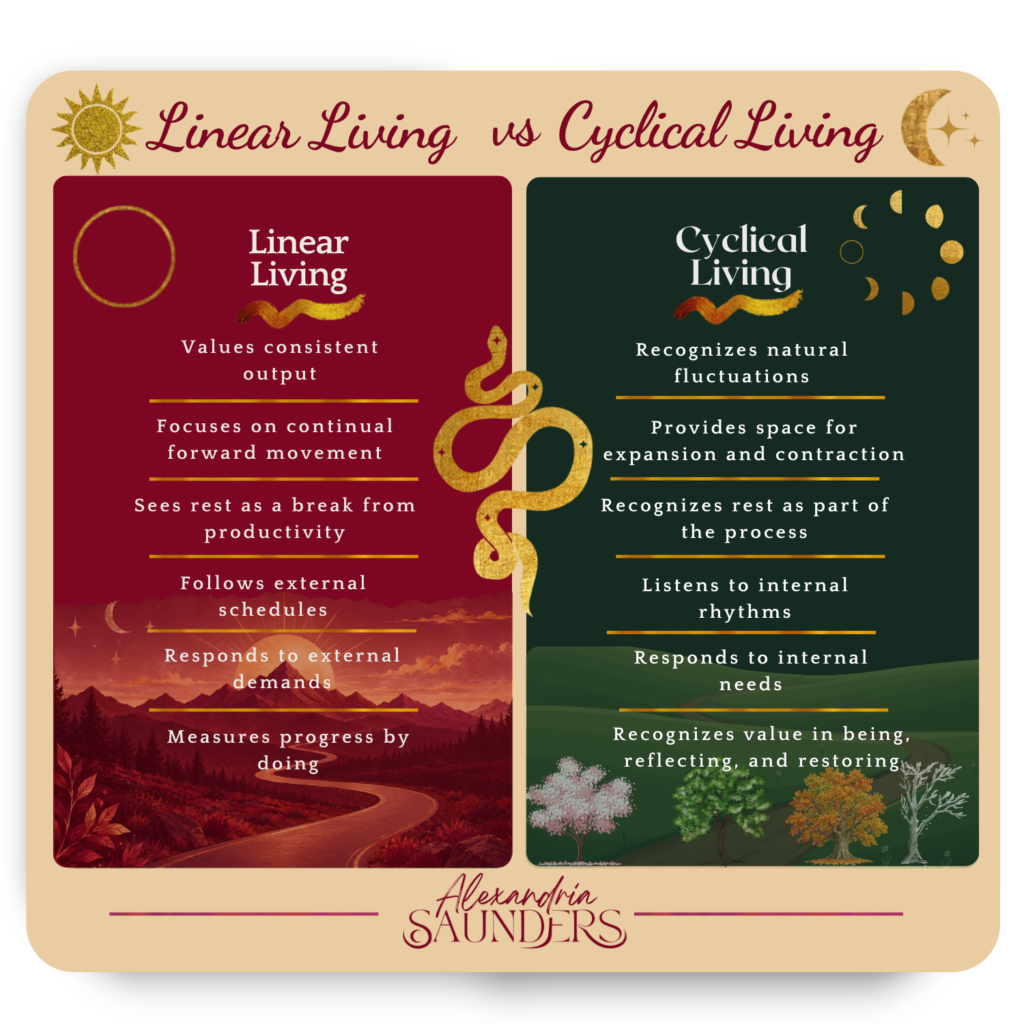
Much of modern life is organized linearly. We make schedules, set deadlines, establish goals, measure progress, and expect ourselves to keep moving forward. Productivity is often measured by how much we accomplish and how consistently we can accomplish it.
There is nothing inherently wrong with structure, goals, schedules, or productivity. Linear thinking helps us function in the world. The problem comes when we begin expecting ourselves to always function this way.
Nature doesn’t.
A garden doesn’t bloom every day of the year. The sun rises and sets. Tides move in and out. Seasons change. Periods of activity are followed by periods of rest.
Cyclical living makes space for that same movement in our own lives. Instead of valuing only continual forward motion, it recognizes expansion and contraction. Instead of viewing rest as an interruption to productivity, rest becomes part of the process. And instead of responding exclusively to external schedules and demands, we begin listening to our internal rhythms and needs as well.
The goal isn’t to replace linear living entirely. Most of us couldn’t function very well if we did. Instead, cyclical living invites us to stop allowing external demands to be the only information we use to decide how we live.
We Live Within Cycles
Once we begin looking for cycles, we find them everywhere.
The 24-hour cycle of light and darkness helps regulate our circadian rhythms. Our breathing continuously moves through expansion and contraction. The moon moves through its phases. Seasons move through growth, abundance, release, and dormancy. Human lives move through stages of birth, growth, aging, and death.
Women may experience additional rhythms through menstruation, pregnancy, postpartum changes, perimenopause, and menopause. Creativity can feel cyclical too. There may be periods when ideas and energy seem abundant, followed by periods when our attention naturally turns toward reflection, integration, or rest.
Not all of these cycles operate on the same schedule, nor do we need to make them line up perfectly.
Cyclical living is less about finding the correct cycle to follow and more about learning to notice rhythms in the first place. We can begin to recognize that change is not necessarily evidence that something has gone wrong. Sometimes change is simply part of the cycle.
The Rhythm of the Seasons
The four seasons provide one of the clearest ways to understand cyclical living because we can see their transitions happening around us.
Spring is associated with emergence and new growth. Summer brings expansion and abundance. Autumn becomes a period of harvest, transition, and release. Winter creates a period of dormancy and restoration before the cycle begins again.
We don’t usually look at a tree in January and decide it has failed because it isn’t producing leaves. Yet we often judge ourselves this way.
We celebrate our own periods of growth, energy, creativity, and productivity, while resisting periods when we feel quieter, slower, or more inward. Cyclical living is about recognizing that these periods also have value.
Winter is not merely what happens between autumn and spring. It has a place in the cycle. Perhaps our own internal winters do too.
Cyclical Living and the Menstrual Cycle
The menstrual cycle provides another powerful way to explore cyclical living. It contains four biological phases: menstruation, the follicular phase, ovulation, and the luteal phase. Rather than experiencing the month as one continuous state, cycle awareness is about noticing what happens with our energy, mood, sexuality, creativity, desire for connection, or need for rest as we transition through those phases.
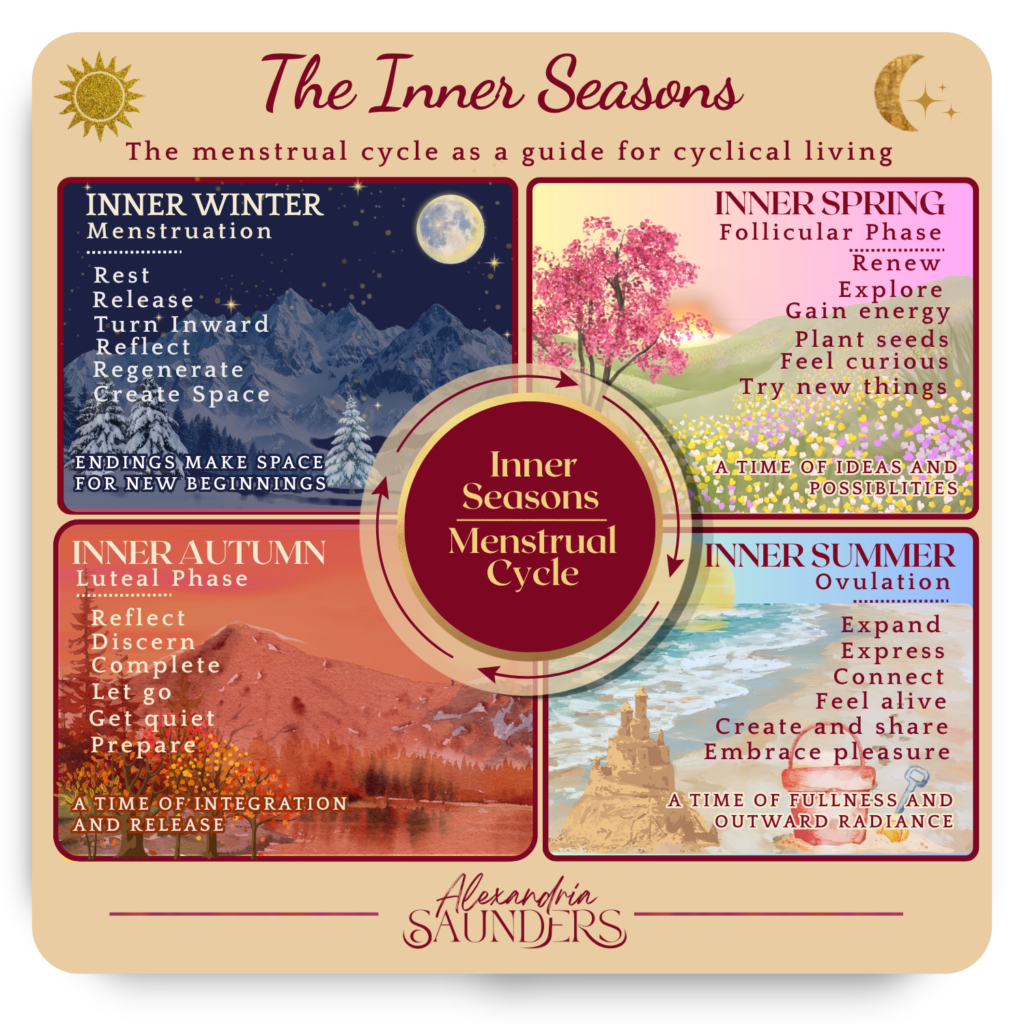
One framework for exploring those changes is known as the Inner Seasons, popularized by Alexandra Pope and Sjanie Hugo Wurlitzer in their work on menstrual-cycle awareness. In this model, menstruation is Inner Winter, the pre-ovulatory or follicular period is Inner Spring, ovulation is Inner Summer, and the premenstrual or luteal period is Inner Autumn.
Inner Winter — Menstruation
Inner Winter corresponds with menstruation. Like winter in the natural world, it can be viewed as a time for turning inward, resting, releasing, and creating space before another cycle begins.
Inner Spring — Follicular Phase
As menstruation ends and the body moves toward ovulation, Inner Spring represents emergence and renewal. Symbolically, it can be a period for curiosity, exploration, new ideas, and beginning again.
Inner Summer — Ovulation
Inner Summer corresponds with the ovulatory portion of the cycle. It represents expansion, expression, connection, and fullness—the metaphorical bloom of the cycle.
Inner Autumn — Luteal Phase
Following ovulation, Inner Autumn represents the transition back inward. It can provide a metaphor for completion, discernment, reflection, letting go, and preparing to return to Inner Winter.
These aren’t rules about how every woman should feel during a particular phase. Individual cycles vary, and even the creators of the Inner Seasons framework emphasize noticing your own shifts rather than expecting your experience to conform to exact days or an archetypal pattern.
That distinction matters because cyclical living shouldn’t become one more external system telling women what they’re supposed to feel.
The point is to pay attention to your body.
Cyclical Living Beyond Menstruation
Cyclical living isn’t limited to women who menstruate. Bodies change throughout life. Pregnancy, postpartum experiences, illness, aging, perimenopause, and menopause can alter familiar rhythms and create entirely new ones. A woman who no longer menstruates hasn’t somehow become disconnected from cyclical life.
Seasonal rhythms, daily rhythms, creative cycles, periods of expansion and contraction, and the changing needs of the body continue. When menstrual rhythms change, cyclical living can become a process of listening for the rhythms that exist now rather than trying to preserve the ones that existed before.
This is also where cyclical living becomes less about following a particular system and more about relationship with the Self. Our needs change. Our bodies change. Our lives change. Listening to those changes requires us to turn inward enough to hear them.
Cyclical Living and Inner Knowing
One of the most meaningful aspects of cyclical living is the opportunity to reconnect with our inner knowing.
Modern life gives us an extraordinary amount of information about what we should be doing. We can find someone to tell us how much to work, when to exercise, what to eat, how to rest, how to be productive, how to heal, how to have sex, and even how to be spiritual.
With so much information coming from outside of us, it can become difficult to hear what is happening within us.
Cyclical living shifts some of our attention back toward the body and Self.
Instead of immediately asking ourselves, “What am I supposed to do?” We begin asking, “What am I experiencing?“ — What does my body need? What feels alive right now? What needs my attention? What am I ready to release?
Inner knowing doesn’t mean ignoring outside information, responsibilities, or guidance. It means allowing our own internal experience to have a voice in the conversation.
How to Begin Living Cyclically
You don’t need to reorganize your entire life around the moon, your menstrual cycle, or the seasons to begin living more cyclically. In fact, the simplest place to start may be by observation.
Pay attention before trying to change anything. Notice when you naturally feel more energetic and when you want to withdraw. Notice when creativity comes easily and when it doesn’t. If you menstruate, track more than the dates of your period. You might also record changes in energy, mood, sexuality, creativity, focus, social connection, and your desire for rest throughout your cycle.
Pay attention to the world around you as well. How do you feel as the seasons change? Does winter affect you differently than summer? Do your routines, appetite, sleep, movement, or desire for connection change at different times of year?
Then experiment with responding to what you notice. Maybe a period of high creative energy is a time to make something rather than postponing it. Maybe a lower-energy day means doing what genuinely needs to be done without adding five unnecessary tasks. Perhaps your body needs vigorous movement one day and stillness another. Maybe a creative block isn’t something you need to force your way through immediately.
This is where self-care can become responsive rather than another fixed routine. Rather than trying to figure out what self-care is supposed to look like, ask yourself, “What would actually nourish me right now?” This responsive approach emphasizes listening to your inner knowing. This is not just a spiritual concept; it also appears in contemporary explanations of cyclical living.
Most importantly, try not to turn cyclical living into another standard you’re failing to meet. You will still have responsibilities during your Inner Winter. Sometimes you will have enormous energy when a framework says you should feel inward. You may have to work when you’d rather rest. Your creativity may arrive at inconvenient times.
The point of cyclical living isn’t to follow a guide created by someone else and assume your body should feel or behave a certain way during each season or phase of your menstrual cycle. You may read, for example, that sexual desire increases around ovulation, but that may not be what you’re actually experiencing. Cyclical living is not about perfectly synchronizing yourself with nature or making your experience conform to a menstrual-cycle chart. It’s about developing enough awareness to recognize the changes that happen within you as you move through different cycles.
Reconnecting With the Rhythms of Life
Perhaps cyclical living isn’t something we need to learn or study, as much as it’s something we need to be aware of.
We already live within cycles. We wake and sleep. We inhale and exhale. We experience beginnings and endings, periods of activity and rest, connection and solitude, creation and release. The natural world continually reminds us that life doesn’t move forward in one uninterrupted line.
When we begin honoring those rhythms instead of continually resisting them, we create space for a different relationship with our bodies and ourselves.
Deepen Your Connection With Your Inner Knowing
Turned On is a nine-month journey into sacred sexuality, Shakti, pleasure, and the Self. Through weekly teachings and practices, periods of exploration and integration, and Alexandria’s one-on-one medicine, Turned On invites you to slow down, listen to your body, and deepen your connection with your own inner knowing.
Rather than following a one-size-fits-all path, Turned On creates space to explore your own rhythms, needs, sexuality, and relationship with the Divine Feminine in a way that honors your individual journey.